A public radio crew from Boston spent time in Fairbanks reporting on a house that had visibly sunk into the ground. The segment aired on Here & Now on September 18, 2026, and it opened with an image that reads as alarming to almost anyone outside Interior Alaska: a home tilting where the frozen soil beneath it had thawed and given way.
To a listener in the Lower 48, that image says one thing. Something went wrong. To a Fairbanks lender, appraiser, or longtime homeowner, it says something narrower and less dramatic. A foundation somewhere stopped doing the specific job it was built to do, and somebody needs to find out why.
That gap between how outsiders read a Fairbanks foundation and how the local market actually treats one is the thing worth understanding before you write an offer or list a house here. The presence of a pile foundation is not the red flag. The absence of maintenance on one is.
What the Piles Are Actually For
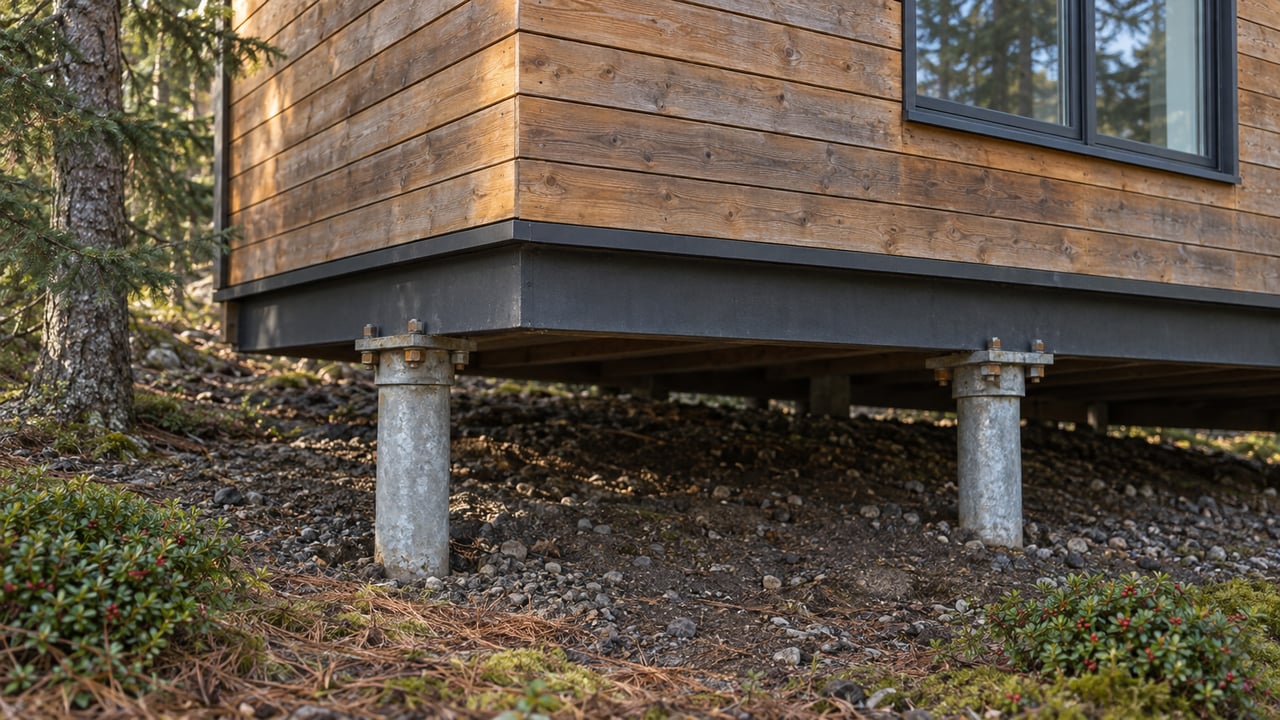
Most homes in Fairbanks and across Interior Alaska rest on steel or timber piles driven far below the surface, often 15 to 30 feet, past the layer of ground that freezes and thaws every year and into soil that stays stable year round. The house sits elevated above the ground on those piles, with open air between the floor and the dirt.
That gap is not a construction shortcut. It exists so cold air can circulate underneath the house and keep the permafrost below it frozen. A slab poured directly on the ground would trap the building's own heat against the soil and start thawing it within a few seasons. In Fairbanks, that design choice is not the exception. It is the standard, expected construction type, and appraisers treat it that way. As AK Home HQ explains, a pile foundation does not get flagged as a negative comparable feature in a Fairbanks appraisal because every reasonable comp on the street was built the same way.
The Line Between Design and Distress
The story changes when a pile foundation shows sloping floors, sticking doors, cracked interior walls, or visible settlement at the corners. That is not the foundation doing its job. That is the ground underneath it moving, and it is usually the result of something disturbing the thermal balance the piles were designed to preserve, whether that is a poorly placed gravel pad, cleared vegetation that let more summer sun reach the soil, or simply an older system that was never built with today's warmer summers in mind.
Researchers at the National Renewable Energy Lab's Alaska campus in Fairbanks have been designing adjustable foundation systems specifically because this kind of movement is becoming more common and less predictable. In a 2024 report, Webcenter Fairbanks quoted Aaron Cooke, an architect and researcher at the lab:
"We see more movement and more subsidence underneath the buildings that we've been designing, and it's changing fairly rapidly."
That is the line a buyer or seller actually needs to draw. Not piles versus slab. Stable versus moving.
What Alaska Law Actually Makes a Seller Say
According to PropCash, Alaska's residential real property disclosure form asks about this directly, under a soil stability question covering settling, slippage, sliding, and heaving. A seller who knows about foundation movement and does not disclose it is not just risking an awkward conversation. Willful non-disclosure under state law can carry treble damages plus costs and attorney fees.
That single question on the form is doing more work than it looks like. It is the mechanism that turns a private maintenance history into something a buyer can actually ask about and verify before closing, which matters more in a place where roughly a third of homeowners have dealt with some version of this than it would somewhere the condition is rare.
The Insurance Gap Nobody Mentions on a Walkthrough
Here is the part that catches people who are financing from out of state off guard. Standard homeowners insurance in Alaska classifies ground movement from permafrost thaw as earth movement, the same broad category that covers earthquakes, and excludes it from typical coverage. Whatever mitigation work a foundation eventually needs, it is not something a claims adjuster pays for. It comes out of the owner's pocket, on the owner's timeline.
That single fact changes how a buyer should think about a home inspection here. An inspector who flags foundation movement is not describing a problem insurance will fix later. They are describing a cost that stays with the house until someone addresses the ground itself.
What This Actually Costs, and to Whom
A University of Alaska Fairbanks survey of 722 homeowners, conducted in early 2022 and published in the journal Ambio in 2024, put real numbers behind how differently this plays out in Fairbanks compared with Anchorage.
| Measure | Fairbanks | Anchorage |
|---|---|---|
| Homeowners reporting effects from permafrost thaw | 51% | 15% |
| Homeowners reporting foundation issues | 33% | 4% |
| Mean mitigation spending per homeowner, over years of ownership | $31,488 | $3,717 |
That $31,488 figure is not a single repair bill. It is a mean across everything a homeowner spent over the years they owned the house, which is the more useful number for anyone weighing whether to buy. It is a recurring cost of ownership in this specific ground, not a one-time surprise.
Across all Fairbanks homeowners surveyed, that adds up to an estimated $226.3 million already spent on permafrost mitigation, according to the same UAF International Arctic Research Center research, about eleven times the total in Anchorage. Zoomed out further, a separate 2025 study reported by Alaska Beacon projected the Fairbanks North Star Borough could face more than $7.4 billion in building-related permafrost costs through the 2060s under a higher warming scenario, the highest projected cost of any borough in the study.
None of those larger numbers should change how a specific buyer evaluates a specific house. What they should change is the assumption that foundation movement here is unusual enough to walk away from outright. It is common enough to have its own line on a state form and its own category in an insurance policy. The question is not whether a house could have this problem. It is whether this particular house has it, and how well it has been managed.
For deep foundation repair work, a Fairbanks contractor's current rate sheet lists heavy residential helical piles running $600 to $800 each, with a 10 pile minimum, as of September 2026. That range gives a rough sense of scale if an inspection turns up movement that needs a structural fix rather than routine monitoring.
What an Appraiser Actually Flags
Lenders including FHA, VA, conventional, and AHFC programs all finance homes with pile foundations built for permafrost conditions. An appraiser evaluating a Fairbanks home looks at the foundation type, its visible condition, and how it compares to similar sales nearby. Because pile foundations are the norm here, their presence alone does not lower a valuation.
That distinction matters most for buyers relocating through military orders or from markets where any foundation other than a poured slab reads as unusual. A pile foundation on a Fairbanks listing is not a defect to negotiate around. A jacked corner with no documented history behind it is.
Questions Worth Asking Before You Write an Offer or List
Before making a decision on a specific property, it helps to get past the foundation type and into its actual history.
- Has the foundation been adjusted, jacked, or releveled, and if so, how many times and when
- Is there a soil stability disclosure on file, and what does it say
- Has a geotechnical or structural engineer looked at the property, and is that report available
- What does the seller's insurance policy actually exclude, and has that been confirmed with a local agent
- Are there visible warning signs nearby, like leaning trees, sunken patches in the yard, or shifted decking
A Few Straight Answers
Does a pile foundation mean a house has a permafrost problem? No. Pile foundations are the standard construction method across Fairbanks and Interior Alaska specifically because they help keep the ground beneath a home stable. Their presence reflects normal local building practice, not an existing issue.
Can you get a mortgage on a home with a pile foundation? Yes. Lenders across FHA, VA, conventional, and AHFC programs close loans on pile foundation homes routinely in this market.
Will homeowners insurance cover future foundation movement? Typically no. Standard policies in Alaska classify ground movement from thaw as an excluded peril, similar to earthquake coverage. Confirming what a specific policy does and does not cover is worth doing before closing, not after.
If you're weighing a specific Fairbanks property and want a straight read on its foundation history, disclosure paperwork, or what a past repair actually means for financing, Ginger Orem has spent three decades helping Interior Alaska buyers and sellers ask the right questions before they sign anything.
This article is general information, not legal, tax or financial advice. Consult a qualified professional about your situation.