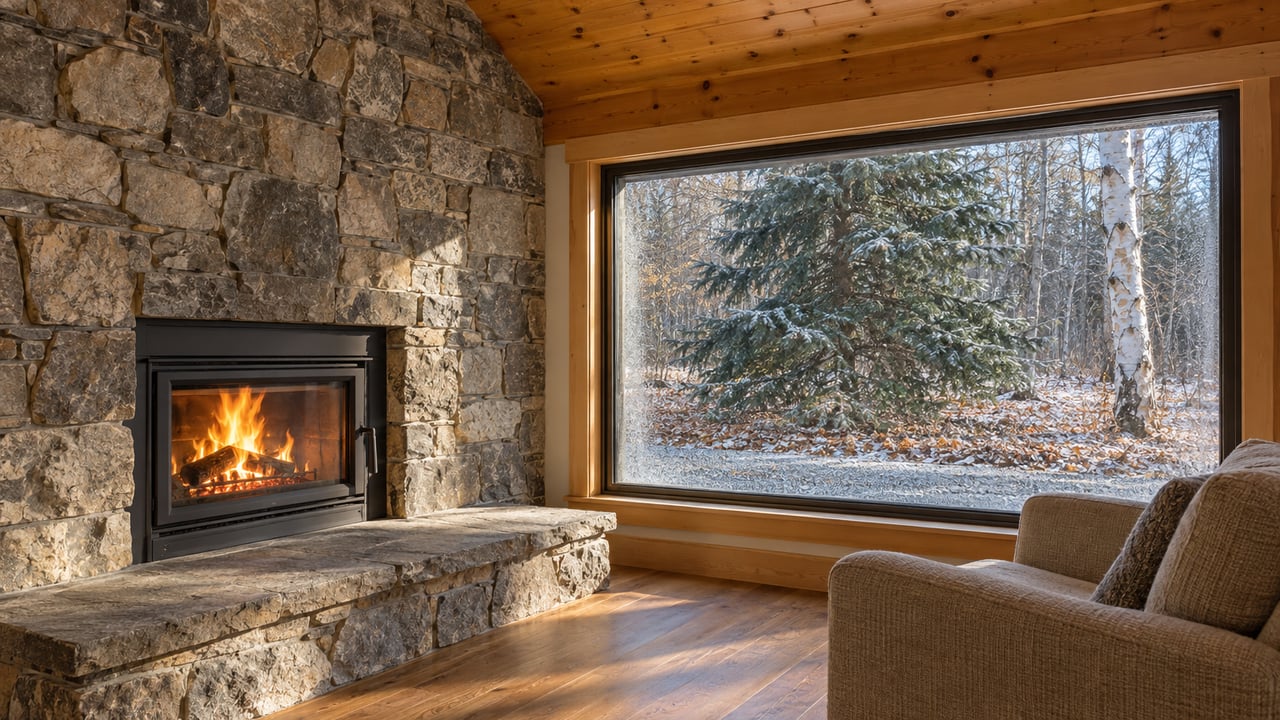
Every EPA-certified wood or pellet stove is supposed to carry a permanent label, usually on the back. In a North Pole living room the stove may be the warmest spot in the house, and nobody looks behind it. During a sale, though, that label decides whether the stove can stay with the home or has to be taken out before closing.
Alaska's Department of Environmental Conservation sets the rule for the Fairbanks North Star Borough PM2.5 nonattainment area, which includes North Pole. Inside that boundary, solid fuel-fired heating devices must be removed before a property is sold, leased, or conveyed if they are 25 years old or older and rated above 2.0 grams per hour. Stoves without EPA certification must go no matter their age. The sale is what triggers the removal. A stove can heat the same house for decades, and the question of whether it stays comes up when the home changes hands.
The Stove's Age Is Counted in the Year You Close
DEC's real estate page gives owners a two-step test:
- Find the emission rate on the label. A rating of 2.0 grams per hour or less means the stove can stay as long as it's registered.
- If the rating is higher than 2.0, subtract the manufacture year from the current calendar year. If the answer is less than 25, the stove can stay.
Applied to a sale that closes in 2026, DEC's test puts stoves rated above 2.0 and built in 2001 or earlier on the removal side. A stove built in 2002 passes in 2026 and reaches 25 years in 2027. Because the test counts the calendar year, a home listed this November that closes in January 2027 moves the cutoff forward one year. A stove that was fine on the day of the offer can be out of compliance by closing day.
The removal itself has a firm deadline. DEC's compliance guidance says removal should happen before the sale closes, or before the lease term starts on a rental. A removed device doesn't have to be replaced, but it must be rendered inoperable. Any new wood or pellet stove that goes in its place has to meet the state's current emission standards for new installations.
DEC lists a few other quick checks:
- No label at all. DEC says the stove is likely not certified, and a stove without a window is another sign of an older uncertified model.
- Cordwood hydronic heaters and most coal-fired devices. These must be removed before closing and rendered inoperable, with one narrow exception for coal devices that pass a DEC-approved wintertime source test.
- Fireplace inserts. These count when they work as a wood or pellet stove set inside an existing fireplace.
- Not affected. Fireplaces without inserts, masonry heaters, oil-fired heaters, and gas-fired heaters.
- Stoves from the Borough change-out program. DEC says these are likely certified and newer than 25 years. If the label shows a rating above 2.0, the stove still becomes subject to removal at sale once it reaches 25.
Registration is a separate step. DEC requires a device to be registered before closing when it's part of a property transaction, and also when someone applies for a waiver or joins the change-out program. Otherwise registration is voluntary. DEC can also grant temporary waivers from the removal requirement case by case. It weighs financial hardship, technical feasibility, and how close the property is to places like hospitals, schools, child care facilities, and senior centers.
The rule applies only inside the mapped boundary. DEC keeps a zoomable online map so owners can check a specific parcel.
The Paperwork Rule That Was Repealed, and the Device Rule That Stayed
Buyers who read up on Fairbanks air quality a few years ago may remember a rule built around real estate transactions. Under 18 AAC 50.081, homes needed an energy rating, the report went to the buyer, and agents had compliance duties of their own. Buyers also had to file a change-of-ownership notification with DEC for wood-fired devices. DEC announced its proposal to repeal that section in October 2025 after clarification from the EPA. The state's filing memo lists the repeal's effective date as December 25, 2025.
The repeal left the device standards in 18 AAC 50.077 for wood and pellet stoves and 18 AAC 50.079 for coal in place. The EPA's 2025 final rule on the Fairbanks plan treats the withdrawn section separately from those underlying removal obligations. DEC's current summary still lists sale-triggered removal of noncompliant wood and coal devices among the rules for the nonattainment area. The paperwork is gone. A stove that fails the label test still has to come out before closing.
A Line Drawn Roughly Along Badger Road
Since 2009, Fairbanks and North Pole have shared a single nonattainment area, as KUAC reported in April. The federal standard is a design value of no more than 35 micrograms per cubic meter. The design value is the three-year average of the 98th percentile of daily PM2.5 readings. DEC Air Quality Division director Jason Olds told KUAC, "The big point is that, for a while now, Fairbanks has been in attainment." The same report said the most recent North Pole design value was still 55, with wildfire smoke days excluded.
On October 16, 2026, DEC put a formal proposal out for public comment. It would split the area into a North Pole air quality zone and a Fairbanks–Goldstream Valley zone. DEC's FAQ says the line would fall roughly along Badger Road. In its statement to the Fairbanks Daily News-Miner, DEC said "the two communities do not experience the same winter air quality conditions." EPA Region 10 Administrator Emma Pokon told the paper, "We still have a bit of work to get to attainment in North Pole, but they've also made tremendous progress over the years."
Nothing changes on the day a split would take effect. DEC's FAQ explains what could come after:
"Over time, North Pole may need to go through additional planning and consider more ways to reduce pollution. That could include prioritized support, such as stove replacement, weatherization, or natural gas connection, where available. It could also include future requirements, such as limits or deadlines for some older, higher-polluting wood stoves."
For Fairbanks, the same FAQ says the area "could face fewer restrictions than if it remained tied to North Pole's air quality." Olds put it in planning terms for KUAC. The current state plan runs through the end of 2027. If the area stays combined and North Pole's levels stay high, he said, planning restarts for everyone: "We'd have to reconsider regulations, potentially more stringent regulations, and for Fairbanks, what we have on the books already has been working."
The reactions are mixed. Borough Mayor Grier Hopkins told KUAC in April, "It is a win some, lose some." Citizens for Clean Air said it opposed the split and called the state's rationale "rooted in streamlined regulatory goals instead of actions that will improve air quality throughout the area." If the state adopts the change, it still goes to the EPA for approval.
What That Means for a Stove South of Badger Road
Taken together, these rules put a 25-year clock on any stove rated above 2.0 grams per hour, and a sale is what makes it count. If the split goes through, any future limits or deadlines for older stoves would be written for the North Pole zone. The Fairbanks side is the area DEC expects could see fewer restrictions. Two similar homes with similar stoves, one on each side of Badger Road, would then be under different long-term plans.
That's also where the help is expected to go. Olds told KUAC that a split would let the state direct federal Targeted Airshed Grant money to the part of the borough that needs it most. The Borough's change-out program already lists these maximum reimbursements for replacing a solid-fuel appliance:
- Gas or propane: up to $12,500
- Oil, emergency backup, electric or heat pump, hot-water district heat, or a Borough-listed pellet stove: up to $7,500
- Catalytic Borough-listed wood stove: up to $5,000
- Removal only, wood, pellet, or coal appliance: up to $12,500
- Hydronic heaters: up to $17,500, depending on the replacement
- Repair of an EPA-certified wood stove: up to $750
To qualify, you must own the property, live inside the nonattainment area, and be replacing an oil, wood, pellet, or coal appliance. Timing matters for sellers. The program has to be contacted before any device is removed, and removals done before approval aren't reimbursed. The page doesn't post a deadline, and the dollar figures are maximums, so call (907) 600-1416 to confirm current funding before scheduling any work.
The Same Label Matters on Alert Days
The label comes up again on cold, still days. DEC issues an Advisory at 15 micrograms per cubic meter, a Stage 1 alert at 20, and a Stage 2 alert at 30. It can target the North Pole zone, the Fairbanks zone, or both. DEC's alerts page says that during Stage 1, solid-fuel devices are restricted unless they have a Stage 1 waiver, a "no other adequate source of heat" waiver, known as a NOASH waiver, a temporary waiver, or an approved exception or exemption. During Stage 2, a Stage 1 waiver no longer counts. Visible smoke must stop within three hours of the alert's effective time. DEC's curtailment details page words the exceptions a little differently, so check with DEC on how they apply to a specific household.
Stage 1 waivers aren't available for uncertified stoves. For older, higher-emitting devices, DEC caps renewals at two conditional one-year waivers before an upgrade is required. Alert status is posted on DEC's Fairbanks air quality site and on the air quality line at 907-451-2132.
Two Hearings and a Comment Deadline
DEC will take oral testimony at two hearings:
- Tuesday, November 17, 2026, 3:30 to 7 p.m., Large Conference Room, Noel Wien Library, 1215 Cowles St., Fairbanks
- Wednesday, November 18, 2026, 3:30 to 7 p.m., Meeting Room, Hotel North Pole, 449 N. Santa Claus Lane, North Pole
Written comments are due by 11:59 p.m. on Monday, November 30, 2026. You can submit them through DEC's online comment form or by email to [email protected], and the state's public notice has the full instructions. For questions about whether a particular stove or insert has to come out before a sale, DEC's contact line is 907-451-5172.
This post is general information, not legal or financial advice. Please confirm how these rules apply to your property with DEC and the right professionals before you list or make an offer.
If you're selling in North Pole and aren't sure whether your stove passes, it's much easier to sort out before listing than in the last week before closing. I'm happy to walk through the label with you and help you plan around it. Ginger Orem has helped Interior Alaska buyers and sellers since 1994. Let's Connect.