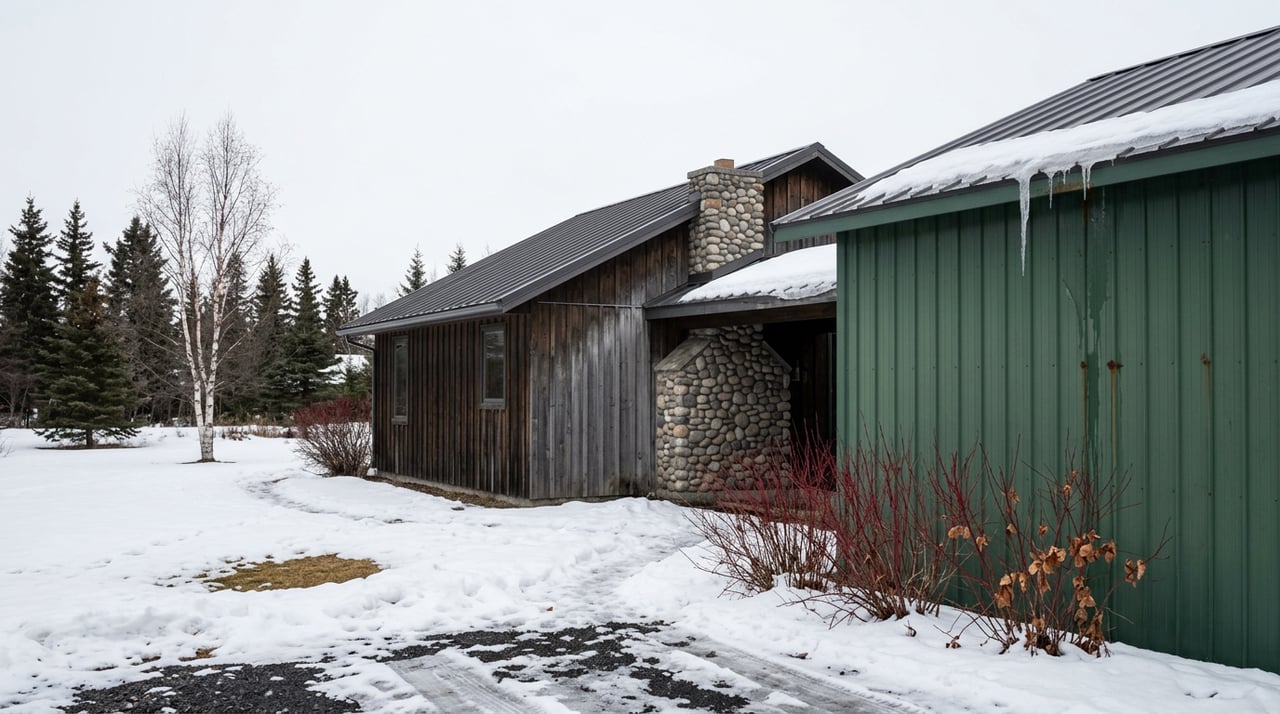
Two North Pole homes, same square footage, same year built, same list price. That pairing isn't hypothetical. Pull up current listings in North Pole this year and you'll find exactly that kind of overlap: one home markets a high-efficiency natural gas boiler installed in 2023, another a wood stove paired with radiant floor heat running off an oil-fired system. Same bedroom count. Same bathrooms. Same number on the sign.
Different bill waiting for whoever signs the closing paperwork.
That difference doesn't show up in price per square foot. It shows up in October, when the first hard freeze sets in, and again in January, when Interior Alaska routinely sits well below zero for days at a stretch. When comparing North Pole homes, price and layout are only part of the picture: the heating system and whether its fuel source is available at a particular address can also affect monthly heating costs.
The Real Question Isn't Which Fuel Is Cheaper. It's Who Sets The Price.
The instinct is to treat this as a simple math problem: natural gas versus heating oil, whichever costs less per unit of heat wins. That instinct misses the actual mechanism.
Natural gas prices in Interior Alaska aren't set by a market that moves day to day. They're set once a year. Interior Gas Utility's board of directors sets the rate every July 1 for the fiscal year ahead, and that rate holds regardless of what happens to oil markets in between. Heating oil doesn't work that way. Its price tracks crude, which means it can be a bargain one winter and a burden the next.
That relationship has flipped before. Back in 2020, IGU's general manager described the cost of natural gas as running about the equivalent of $2.75 a gallon in heating oil terms, and noted that with oil trading well below that at the time, homeowners had less financial incentive to convert. Cheap oil made gas conversions a harder sell. The same math runs in reverse whenever oil spikes.
The utility's own online rate calculator makes this visible rather than abstract: it prices natural gas at $2.48 per hundred cubic feet, a figure the utility updated as recently as May 2026, and it asks you to plug in your own local heating oil price because that side of the comparison changes throughout the year while the gas rate doesn't. That's the actual product being sold when a North Pole home is on the mainline: not a guaranteed discount, but a fixed number you can plan a winter budget around.
Why This Argument Lands Differently In North Pole
This distinction matters more in North Pole than almost anywhere else in the borough, because North Pole is where the mainline is still being built.
As of January 2026, IGU served 3,600 customers across the region, a customer base that has tripled over the past six years as the utility extends pipe into more streets. That same report names North Pole specifically as the utility's largest area of current growth. But growth from a smaller base still means a smaller network: as of October 2025, IGU operated roughly 150 miles of mainline in Fairbanks against 85 miles in North Pole. Fairbanks proper has had gas longer and has a denser web of pipe to show for it. North Pole is newer territory, which means access there is far more address-dependent.
North Pole's relationship with this utility has its own short history. The city didn't have a reliable local gas supply until IGU completed a dedicated storage facility near the old Flint Hills Resources Refinery site off the Old Richardson Highway. As KUAC reported, then-Mayor Mike Welch said at the 2021 ribbon-cutting:
"We're not dependent on the one that comes all the way off of Peger Road to get gas out here for our customers."
Before that facility existed, North Pole's gas supply depended on infrastructure built around Fairbanks first. The city has been playing catch-up on its own energy independence for years, and the current build-out is the visible result.
What The 2024 Construction Season Actually Changed
The Fairbanks Daily News-Miner reported that IGU installed 16 miles of new mainline and 475 new service lines in 2024, the most mainline the utility had added in a single year since 2015. Most of that work went into North Pole, concentrated on Hurst Road, Dawson Road, and Flight Street. If you're comparing a home on one of those streets against a home a half mile north of Hurst Road, you're comparing two different infrastructure realities even though both addresses say "North Pole" on the listing.
As of early 2025, design work for the next phase, covering the area north of Hurst Road, was reported at about 65 percent complete, with actual construction dependent on grant funding rather than a fixed calendar. That's a fair characterization of where things stand: planned, partially designed, not guaranteed on any specific timeline.
There's also a cost mechanic buyers rarely think to ask about. IGU subsidizes the physical hookup heavily. Installing a service line reportedly costs the utility around $5,000, but it bills residential customers just $350 for it. In exchange, the service agreement requires the customer to turn service on within six months of installation, or the utility will bill for the full cost. If a previous owner had a line installed and never activated it, that clock may already be running, or it may reset at closing depending on how the utility handles ownership transfer. Either way, it's a question worth asking directly rather than assuming.
What To Ask Before You Fall For The Floor Plan
A few questions turn this from an abstraction into something you can act on before you write an offer:
- Is this specific address already connected to the gas mainline, or just sitting in a service area that's still being designed?
- Which street is it on, and does that street match the 2024 build-out (Hurst Road, Dawson Road, Flight Street) or the still-in-design area north of Hurst Road?
- If there's a stubbed line but no active service, has the six-month activation window already started, and who's responsible for that cost at closing?
- If the home runs on oil or wood, what has the current owner actually been paying, and does that number reflect a cheap-oil year or an expensive one?
These questions can help you assess what you may spend to heat the home.
Here's how the three common heat sources in North Pole stack up on the question that matters, not raw cost, but who controls the price:
| Natural Gas (IGU) | Heating Oil | Wood / Pellet | |
|---|---|---|---|
| Price reset | Once a year, every July 1, by IGU's board | Floats with crude oil markets | Set by local suppliers, tracks lumber and pellet costs |
| Upfront cost to add | Utility-subsidized hookup, $350 residential fee against IGU's own reported $5,000 install cost | None if tank and burner already in place | Stove or boiler purchase, plus storage space |
| Where it's available | Expanding street by street, tied to grant-funded construction phases | Anywhere a delivery truck can reach | Anywhere with room to store fuel |
The Map Isn't Finished
None of this is static. Harvest Midstream's new North Slope liquefaction facility, which began supplying IGU in October 2025, can produce up to 150,000 gallons a day, triple the capacity of the utility's prior source, and was built with room for further expansion if demand grows. IGU pushed that supply hard this past winter, hitting a single-day record of 138,000 gallons delivered on January 8, 2026. A house that can't get gas today isn't necessarily locked out for good. A house that has it today isn't guaranteed anything about the house next door.
That's the actual takeaway for anyone comparing North Pole properties this year. The list price tells you what you'll owe at closing. It doesn't tell you what street you're on, or what that street means for your February heating bill five years from now.
A Few Straight Answers
Is natural gas always cheaper than heating oil in North Pole? Not always, and not by a fixed amount. The relationship has flipped before when oil prices dropped. What gas access reliably offers is a rate set once a year rather than one that moves with global crude prices.
What if a home has a gas line installed but not turned on? Ask when the service line went in. IGU's standard agreement requires activation within six months of installation or the customer is billed the full, unsubsidized cost. Find out where that clock stands before you close.
How do I find out if gas has actually reached a specific North Pole street? Given how quickly the build-out is moving, the most reliable answer is a direct check with Interior Gas Utility close to your offer date, not whatever an agent or a neighbor told you last year.
If you're weighing a North Pole property against what it will actually cost to heat, that's exactly the kind of detail worth running down before you write an offer, not after. Ginger Orem has spent three decades working these streets in Interior Alaska and knows which ones to ask about. Let's Connect.
This article is general information, not legal, tax or financial advice. Consult a qualified professional about your situation.